Tuesday, September 5, 2017

The pioneering continent

ARE small cargo drones the answer to some of Africa’s most pressing problems? A group of European engineers supported by IBM thinks so. Christened “flying donkeys” and now in development, the drones will carry 10kg (22 pounds) of cargo each over distances of up to 120km (75 miles) to supply medicine to remote communities or food to refugees.

 They are designed to be cheap and rugged enough to deploy across the continent, and could perhaps serve as a proving ground for retailers like Amazon that are unable to experiment as freely in the rich world because of strict regulations. Test flights are planned in Africa for later this year. The continent is regarded as an ideal arena because its airspace is not congested, and because poor roads mean that demand for cheap air cargo is immense.

Experiments such as this underscore a remarkable change taking place in Africa. A continent that has long accepted technological hand-me-downs from the West is increasingly innovating for itself. To be sure, much of this is made possible by technological advances elsewhere. Mobile phones are common today in even the most remote African villages. Ericsson, a technology company, estimates that the number of mobiles will rise to 930m by 2019, almost one per African. The spread of smartphones, some of which now cost as little as $25, is likely to push internet penetration to 50% within a decade.

This is now allowing Africans to go beyond merely copying technology used elsewhere or adapting it to fit African circumstances. In some cases, firms are generating innovations that can also be used in rich countries. Mobile money is the best example. A technology that long struggled to gain a foothold in the West (though mobile payments now seem to be taking off after the introduction of Apple Pay) has transformed economies in places such as Kenya, where millions of unbanked people have been brought into the financial system. This in turn has spurred yet another wave of innovation.

Firms are using mobile money to sell life-insurance policies, some to people with infections such as HIV. Phones not only reduce the cost of collecting small premiums but also allow insurers to remind customers to take their medicine. Another innovator is Olam, a Singapore-listed farm-commodity firm. It has signed up 30,000 farmers in Tanzania as suppliers of coffee, cotton and cocoa through a mobile-phone system, boosting profitability for all.

New technologies could also make a great difference in education. Although firms around the world are developing smartphone and iPad apps to teach children to read, write and do sums, these innovations promise to have a far greater impact in Africa, where education systems are weak and children often have to walk long distances or pay prohibitive fees to attend school.

Apps and e-learning schools are no match for the best state or private ones, but only a tiny elite has access to those. Compared with the run-of-the-mill schools that most Africans attend, they look impressive. The main advantage of using technology to teach is that it reduces the impact of two common failings in many ordinary schools in Africa: teacher absenteeism and minimal adherence to the curriculum. Among the firms embracing such innovation is Bridge International Academies, partly funded by Pearson, co-owner of The Economist. It has more than 100,000 nursery and primary pupils in Kenya, paying about $5 a month to attend low-cost schools that use technology to follow standardised curriculums.

Technology companies are also having an impact on African societies by transforming the media. The 300,000 residents of the Kenyan city of Nakuru have never had their own newspaper, relying instead on word of mouth for local news. That changed last year when a news website, HiviSasa (meaning “Right Now”), started publishing 30 reports a day on fires, murders, school graduations, hospital improvements and much else that few people outside Nakuru would care about. On March 13th its headline read, “Teacher rescued from 45-feet toilet”.

Innovation in Africa is helped by a peculiar confluence of economic and political circumstances. Regulation is generally light thanks to weak governance; engineers can try things out that are either prohibited or prohibitively bureaucratic elsewhere. It is also buoyed by the paucity of traditional infrastructure, whether roads or landlines, meaning that new technologies or business models face few established competitors.
This business environment has attracted a growing number of Western companies to Africa. Microsoft is funding a small firm that is developing wide-area Wi-Fi systems able to cover entire regions at less than a hundredth of the cost of existing mobile telephony. It uses unallocated frequencies, including ones previously reserved for television that are being freed up as broadcasters move to digital transmissions that use less bandwidth. The intention is to bring the same model to rural communities in the West.

Technology is opening up African markets that have long been closed or did not previously exist, says Jim Forster, one of the early engineers at Cisco, a maker of network gear, and now an angel investor. Facebook has joined up with phone operators to make internet connectivity available free through an initiative known as internet.org, hoping to sign up Africans to its site before indigenous social media get to them. Launched in Africa last year, it has since been expanded to poor countries on other continents. Of all Western technology firms, IBM is perhaps the keenest on Africa. Virginia Rometty, the head, visits regularly and talks of “great, great innovation” coming out of the continent.

Africa’s innovation revolution is still in its infancy. But it is likely to gain pace, not least because new models and forms of financing start-ups are also being developed. Take EmergingCrowd, a London-based crowdfunding firm that was launched this week. It aims to match investors with companies in emerging markets, predominantly in Africa. One of the first firms to raise money on it is Bozza, a market for African music and film producers who would otherwise struggle sell their work. “The problems Africa faces are not necessarily American or European problems,” says Emma Kaye, its founder. “The solutions are likely to come out of Africa.

Advancements & Achievements


By Rowan Philp
A South African research center—the Council for Scientific and Industrial Research (CSIR)—was the driving force behind the world’s lithium batteries, from those in your laptop to cell phones and the Chevy Volt, in addition to the time machine now used by the world’s leading road engineers.
And the SABLE Accelerator understands that South Africa’s CSIR, a government- and private sector-funded research and innovation hub, has just made a major global breakthrough in laser technology, which could help shape the future as fundamentally as the “tube” behind television.
This technology was developed by the CSIR's National Laser Centre and is the world's first digital laser, which allows the laser beam to be manipulated into multiple shapes, whereas traditional lasers appear only as a small point. While it is still being refined, this multifunctional technology will ultimately simplify numerous applications and will have implications across a number of industries. Watch the video below to learn more.
In June 2013, the CSIR's National Laser Centre also invented the flame lens—a system that literally uses fire to focus powerful laser beams that would otherwise destroy conventional glass lenses.

Focusing the brainpower of 2,500 scientists, inventors and developers, the CSIR has quietly, over the past 68 years, developed everything from the world’s first injectable plant-produced medicine and a satellite-based fire warning system to aircraft design tools and a low-cost computer for the blind. Yet many promising inventions are literally sitting on the shelves of its sprawling Pretoria campus, waiting for the entrepreneurial catalyst needed to convert inventions into innovations and improve lives around the globe.
In a world first, the CSIR has invented a system that cheaply prevents train derailments by monitoring the entire track with guided ultrasound waves. A pilot unit on two lines in South Africa prevented two inevitable derailments in a single year, according to the CSIR, which listed the average cost of each derailment at $5 million. But this solar-powered breakthrough technology—which does not interfere with train operation—still awaits a commercial partner to go to market.

With an annual turnover of roughly $200 million, income from about 30 active technology licensing agreements was $2 million last year. About 12 new license agreements are concluded annually. According to its new Head of Technology Transfer, Dr. Sean Moolman, this was in line with the international R&D institution benchmark of 1 to 3 percent but remains at the lower end.

Some $130 million (roughly 70 percent) of the research center’s turnover is derived from contract R&D funding. However, Moolman said a major push was underway to increase the rate of start-up formation and licensing activity to commercialize a raft of new technologies.
Recently launched start-up companies include ReSyn Biosciences, offering highly customizable and ultra-high-performance microspheres for life sciences research; Tuluntulu, a company with a low-bandwidth adaptive video streaming technology platform for the developing world; and Persomics, which offers a platform for miniaturized high-throughput screening and experiments.

Moolman said it was also long overdue that South African funders, stakeholders the general public, foreign investors and strategic partners be made aware of the keen cutting-edge technology innovation at the southern tip of Africa.


A Little-Known Legacy of World-Class Innovation

Ask average South African businesspeople what their country has invented, and a
handful might suggest the automated pool cleaner and the CT scan. In fact, the list runs to dozens of major breakthroughs, including CSIR inventions like the Tellurometer, the world’s first microwave distance-measuring instrument. In medical research alone, South African innovations include electron

crystallography, epigenetic therapy for blood cancers, the human heart transplant and the first barrier to STD transmission—including HIV—for women).


Ask the same group in what research areas their country is a world leader, and some might suggest banking and mining technologies and perhaps vaccines. In fact, South Africa is a world leader in everything from cell culturing to micro-satellites and the technologies of light—a core innovation hub for the CSIR.

At the most exotic end of this field, the council’s laser research group has developed devices that compete at the leading edge of the global industry, particularly in the mid-infrared range, which has applications for everything from surgery to protecting aircraft from heat-seeking missiles. It has formed a partnership with the world’s most famous optics maker, Carl Zeiss, in customizing its laser devices for next-generation missile guidance.

SABLE understands that the team has also invented a brand-new kind of laser, which promises to have a major impact in laser characterization and in fiber-optic communications. Moolman declined to provide details on the breakthrough, saying a major announcement on the implications is due to be made by the government in the weeks to come. However, he did note, “These guys are doing absolutely amazing things—they already have more than five world records for laser performance.”

The Companies Spinning Off From CSIR Innovation
Another new spin-off company, UViRCO, now leads the world in a multispectral imaging technology that was entirely invented by South Africans: the ability to detect the corona electricity leakage from power lines and sub-stations.

CEO Dirk Lindeque told SABLE the new company had already sold 320 imaging cameras and 20 large multi-cam devices to power utilities and universities from China to South America. However, the journey from invention to profitability has taken 20 years. Lindeque was a research team leader and part of a team who invented the world’s first night time corona imaging device in 1991, with a second full daylight version created in 1993.

But Lindeque said utilities were increasingly recognizing the cost and energy savings behind identifying leakages and potential blackout damage, and he noted that UViRCO’s engineers were now developing a tool to accurately quantify the losses.

And in yet another light-related technology, the CSIR has commercialized the CANDLE portable landing light system, in which remote-controlled visible or infrared lights are placed for disaster relief aircraft or military paratroopers. Already used by a number of defense forces—and having won an International Soldier Technology Award (2006)—an upgraded version incorporating an early warning system is now ready for licensing with industrial partners and military contractors.


However, if South Africa is to be known for the new light of lasers in the future, its greatest scientific pedigree currently is the technology to unlock the oldest light in the universe—not just the visible light of the most distant galaxies, but light so old that it has been stretched into microwaves and radio waves.
Already home to the world’s most powerful single optical telescope—the locally designed, 10.5-meter Southern African Large Telescope—South Africa is now leading the development of the world’s largest telescope of any kind, the Square Kilometer Array. Local scientists are currently building 64 locally invented radio dishes for the SKA’s precursor, the MeerKAT array, following a massive materials testing process by the CSIR.

Beyond the engineering of light, the CSIR’s portfolio of innovation extends to metal casting, technologies for poverty eradication and the life sciences. Moolman said the Persomics start-up could revolutionize DNA screening and be a core enabler for personal genomics.
Resyn Biosciences, the Pretoria-based start-up, enters the highly competitive world of “bead” biotechnologies, in which tiny artificial particles are coated with a variety of substances for medical and research use.

While existing companies offer solid or cracked micro beads, Dr. Justin Jordaan, a team leader behind the company’s patented design, says Resyn technology featured a polymer matrix with vastly higher surface area for absorption. The beads are also the first to use a compound called PEI as the primary ingredient of the matrix tangle. And, says Jordaan, the patented microspheres are magnetic, which means they can be separated from a substance they’re immersed in, like blood, simply with the use of a magnet.

Bridging the Gap Between Breakthrough and Business
In a recent article on the technology transfer effort, CSIR CEO Sibusiso Sibisi suggested, “Arguably, one of the biggest impacts CSIR research has had on an industry is in the development of the lithium ion battery, which has literally changed the world. All major manufacturers have been licensees of CSIR intellectual property.”

In the 1980s, CSIR researchers Mike Thackeray and Johan Coetzer developed spinel and other technologies, which are now fundamental to high-power, rechargeable batteries. Royalties have flowed ever since. However, in the 1990s, the CSIR and its funders at Anglo American made the ill-fated decision to suspend the development of the batteries, leaving the U.S. and others to inherit a future lithium economy worth untold billions.


In a recent paper, Thackeray lamented his mistake, saying, “One cannot help but wonder what would have happened if Anglo and CSIR had decided to invest in lithium battery technologies over the long term.”
Instead, it has been innovations like the Heavy Vehicle Simulator (HVS) that have led to income for the institute. Developed in the 1980s, the HVS was the world’s first—and still leading—accelerated pavement tester, a virtual time machine that precisely simulates, within three months, what a stretch of road will look like after 20 years of traffic and weather. Now undergoing a revolutionary seventh iteration, the HVS is a 55-ton machine that forces a truck bogie onto a road surface under tons of pressure and runs it back and forth across a 12-meter track. It also features finely tuned simulations for extreme heat, cold and weather, in addition to intensive data analysis support to customers.

The California Department of Transportation uses two of the massive units to plan the complex recipe of asphalt, gravel and other layers for its roads. Chris Rust, the original pioneer of the simulator, told SABLE that 12 of the $2 million units have been sold, in addition to double-sized $4 million versions for aircraft runway testing for the US military and FAA.

“We used to sell one every two years; now it’s three each year, and we currently have three being built with three more in the pipeline,” he says. Rust said one of the invention’s unique features was that it was mobile and used on actual roads rather than test strips. And now, 20 years after the roll-out of the unit’s commercial version, simulated wear-and-tear can be compared to actual damage done over 20 years of traffic and weather.

Rust said California road officials were stunned when shown photographs of a 1992 HVS test strip alongside photographs of that same road taken last year. “The conditions were the same!” says Rust. The time machine had passed its ultimate test. He said the latest version would triple the simulation speed while dramatically reducing cost and size by removing all hydraulic systems from the unit. Rust could not reveal details of the patented mechanism, which would replace the hydraulic motors.

If the process can be imagined like a circular pizza knife being pressed through a pizza, the new system is to drive a set of wheels into roads with the pressure of 40 tons, at a speed of 40 kilometers per hour, for weeks on end.
South African innovation springs from eight publically funded science research councils, universities and the private sector. But the CSIR remains the engine behind the national effort.

According to the government’s 10-Year Innovation Plan, by 2018 South Africa should: be one of the top three emerging economies in the global pharmaceutical industry; deploy multiple space satellites, including at least one launched from its own territory; and achieve a 25-percent share of the global hydrogen and fuel cell catalysts market with novel platinum group catalysts.

The Completed CSIR Innovations Awaiting Partners
Some of the CSIR’s ready-for-transfer technologies appear to hold promise to contribute to South Africa's lofty innovation goals. Some of these include:
  • A wireless mesh technology that provides affordable Internet connectivity to rural villages. Already rolled out to 185 rural schools in a pilot project in South Africa, Broadband 4 All uses low-cost local infrastructure and peer-to-peer communication rather than the traditional point-to-multi-point model. The system assigns clusters of schools to village operators within a network designed for resilience and even cultural acceptance. The model is currently inviting expressions of interest from potential commercial partners.
  • The world’s first risk-free bioreactor. While most cell culturing is a 2D process in a petri dish or on 3D scaffolds in which delicate cells can be damaged when removed, the CSIR’s invention effectively detaches the cells with the flick of a temperature switch, allowing the cells to safely float off their mounts. 
  • A low-cost maternal ultrasound device, called Umbiflow, which uses Doppler technology to detect small-size fetuses that need intervention at rural and primary care facilities. With nine out of 10 pregnant mothers unnecessarily referred to hospitals using current fetal measurement techniques in the developing world, the CSIR invention—by measuring umbilical blood flow—identifies the 10 percent of cases in which small-for-gestational-age fetuses are unhealthy and in need of hospital intervention. The system has also been credited with preventing perinatal deaths by up to 38 percent while reducing costs for mothers and hospitals.
  • A bio-artificial liver support system, which channels patient’s blood through a liver cell bio-reactor using a unique emulsion carrier. This patented system has potential applications in tissue engineering, 3D cell culturing and lifesaving therapies.
  • Rheostat semi-solid metal casting, a potential environmentally friendly solution to making everything from aerospace components to bicycle frames and prosthetics. The patented system from the institute’s advanced casting technologies group allows lightweight metal components to be cooled and cast into their final shape in a single step while recycling unused metal and reducing scrap to under 5 percent—a level not yet achieved in the global casting industry.

About the CSIR
The CSIR is one of the leading scientific and technology research, development and implementation organizations in Africa. Constituted by an Act of Parliament in 1945 as a science council, the CSIR undertakes directed and multidisciplinary research, technological innovation, as well as industrial and scientific development to improve the quality of life of the country’s people.

The CSIR is committed to supporting innovation in South Africa to improve national competitiveness in the global economy. Science and technology services and solutions are provided in support of various stakeholders, and opportunities are identified where new technologies can be further developed and exploited in the private and public sectors for commercial and social benefit.
The CSIR’s shareholder is the South African Parliament, held in proxy by the Minister of Science and Technology. More information is available at http://www.csir.co.za.

Bio
Rowan Philp served as Chief Reporter and Foreign Correspondent for the Sunday Times in South Africa for most of the past decade—a period broken by stints at the Washington Post as Deputy News Editor; a Harvard/MIT fellowship; and two years as London Bureau Chief. Previously, he was based in Boston and served as the North American correspondent for the Sunday Times and Mail & Guardian, reporting on South African expatriates and diplomats, as well science and innovation. He isa currently chief reporter in South Africa for The Witness daily newspaper of KwaZulu-Natal and Media24.

In his 20-year career, Philp has reported from 27 countries around the world, from Haiti and Libya to the civil war in the Philippines and the World Economic Forum at Davos, as well as covering the past four US presidential elections. He has twice been awarded South Africa’s highest national print reporting prize, the Vodacom South African Journalist of the Year
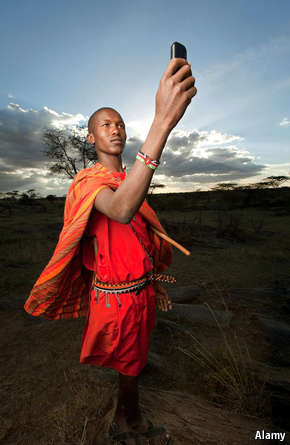
Consolidated African Technologies (Pty) Ltd

Company profile

CAT was established in 1990 and has been a leading provider of ultra-rugged data collection solutions since its establishment.
Our systems are installed at over 450 sites throughout Africa in Botswana, Cameroon, Lesotho, Kenya, Malawi, Mali, Namibia, Nigeria, Rwanda, Swaziland, South Africa, Tanzania and Zambia.
 We have sold in excess of 11000 ultra-rugged handheld computers and are widely known as the leading meter reading solutions provider throughout the continent of Africa.

Other data collection systems have also been developed in house and CAT is a one stop shop when it comes to data collection in hazardous or extreme environments.

CAT’s software is also setting the trend as far as meter reading solutions are concerned and the features and functions available within our systems is much more elaborate and
user focused than those available anywhere else. Powerful reporting and behaviour driven meter reading processes ensure that the quality of meter reading data returned by a
CAT system far surpasses anything collected by any other method.

New to the market of monitoring dispensing of fuel from company and government depots as well as mobile refuelling trucks CAT is fast expanding our business into this arena as well.
Our solutions provide an easy way to ensure that fuel is only dispensed into authorised vehicles, containers and tools.

Cat truly is a one stop shop for any data collection or monitoring needs in outdoor, extreme and hazardous environments.

Product & services

CAT specializes in data collection, assessment and monitoring for extreme or hazardous environment applications. These can include anything from meter reading to tracking of assets in mines and on railways to monitoring dispensing of fuel or cathodic protection on major pipelines.

CAT’s Enterprise Meter Reading Software dubbed Routemaster Africa.Net is our flagship product and in conjunction with the Radix range of ultra-rugged handheld equipment and user friendly function rich mobile software forms the ultimate meter reading solution.

Additional technologies such as Smart AMR (Automated Meter Reading), Walk by AMR, GPS, Remote communications via 3G/GPRS, Bluetooth printing, in field integrated imaging can modularly be added to build a perfect system to user requirements and budget

Mogale City - Over 21 years of service


CAT has been awarded the tender for an upgrade to and refresh of the current
meter reading software and hardware in use at their sites. The original system
was supplied by CAT in 1993 and even though additional devices was purchased
since and the odd software update done it is still the same Radix FW60
technology operating there today as was originally implemented in 1993. This
officially makes Mogale City (previously known as Krugersdorp Municipality)
the client that has operated a single technology for the longest time - 21 years.
CAT Meter Reading Systems - There for the long run.

Great achievements in science and technology in ancient Africa


Despite suffering through the horrific system of slavery, sharecropping and the Jim Crow era, early African-Americans made countless contributions to science and technology. This lineage and culture of achievement, though, emerged at least 40,000 years ago in Africa. Unfortunately, few of us are aware of these accomplishments, as the history of Africa, beyond ancient Egypt, is seldom publicized.

Sadly, the vast majority of discussions on the origins of science include only the Greeks, Romans and other whites. But in fact most of their discoveries came thousands of years after African developments. While the remarkable black civilization in Egypt remains alluring, there was sophistication and impressive inventions throughout ancient sub-Saharan Africa as well. There are just a handful of scholars in this area. The most prolific is the late Ivan Van Sertima, an associate professor at Rutgers University. He once poignantly wrote that “the nerve of the world has been deadened for centuries to the vibrations of African genius”

Here, I attempt to send an electrical impulse to this long-deadened nerve. I can only fly by this vast plane of achievements. Despite this, it still should be evident that the ancient people of Africa, like so many other ancients of the world, definitely had their genius.

Math
Surely only a few of us know that many modern high-school-level concepts in mathematics first were developed in Africa, as was the first method of counting. More than 35,000 years ago, Egyptians scripted textbooks about math that included division and multiplication of fractions and geometric formulas to calculate the area and volume of shapes.


Distances and angles were calculated, algebraic equations were solved and mathematically based predictions were made of the size of floods of the Nile. The ancient Egyptians considered a circle to have 360 degrees and estimated Π at 3.16

Eight thousand years ago, people in present-day Zaire developed their own numeration system, as did Yoruba people in what is now Nigeria. The Yoruba system was based on units of 20 (instead of 10) and required an impressive amount of subtraction to identify different numbers. Scholars have lauded this system, as it required much abstract reasoning

Astronomy
Several ancient African cultures birthed discoveries in astronomy. Many of these are foundations on which we still rely, and some were so advanced that their mode of discovery still cannot be understood. Egyptians charted the movement of the sun and constellations and the cycles of the moon. They divided the year into 12 parts and developed a yearlong calendar system containing 365 ¼ days. Clocks were made with moving water and sundial-like clocks were used

A structure known as the African Stonehenge in present-day Kenya (constructed around 300 B.C.) was a remarkably accurate calendar (5). The Dogon people of Mali amassed a wealth of detailed astronomical observations (6). Many of their discoveries were so advanced that some modern scholars credit their discoveries instead to space aliens or unknown European travelers, even though the Dogon culture is steeped in ceremonial tradition centered on several space events.

The Dogon knew of Saturn’s rings, Jupiter’s moons, the spiral structure of the Milky Way and the orbit of the Sirius star system. Hundreds of years ago, they plotted orbits in this system accurately through the year 1990 (6). They knew this system contained a primary star and a secondary star (now called Sirius B) of immense density and not visible to the naked eye.

Metallurgy and tools
Many advances in metallurgy and tool making were made across the entirety of ancient Africa. These include steam engines, metal chisels and saws, copper and iron tools and weapons, nails, glue, carbon steel and bronze weapons and art

Advances in Tanzania, Rwanda and Uganda between 1,500 and 2,000 years ago surpassed those of Europeans then and were astonishing to Europeans when they learned of them. Ancient Tanzanian furnaces could reach 1,800°C — 200 to 400°C warmer than those of the Romans (8).

Architecture and engineering
Various past African societies created sophisticated built environments. Of course, there are the engineering feats of the Egyptians: the bafflingly raised obelisks and the more than 80 pyramids. The largest of the pyramids covers 13 acres and is made of 2.25 million blocks of stone .

Later, in the 12th century and much farther south, there were hundreds of great cities in Zimbabwe and Mozambique. There, massive stone complexes were the hubs of cities. One included a 250-meter-long, 15,000-ton curved granite wall (9). The cities featured huge castlelike compounds with numerous rooms for specific tasks, such as iron-smithing. In the 13th century, the empire of Mali boasted impressive cities, including Timbuktu, with grand palaces, mosques and universities

Medicine
Many treatments we use today were employed by several ancient peoples throughout Africa. Before the European invasion of Africa, medicine in what is now Egypt, Nigeria and South Africa, to name just a few places, was more advanced than medicine in Europe. Some of these practices were the use of plants with salicylic acid for pain (as in aspirin), kaolin for diarrhea (as in Kaopectate), and extracts that were confirmed in the 20th century to kill Gram positive bacteria.

Other plants used had anticancer properties, caused abortion and treated malaria — and these have been shown to be as effective as many modern-day Western treatments. Furthermore, Africans discovered ouabain, capsicum, physostigmine and reserpine. Medical procedures performed in ancient Africa before they were performed in Europe include vaccination, autopsy, limb traction and broken bone setting, bullet removal, brain surgery, skin grafting, filling of dental cavities, installation of false teeth, what is now known as Caesarean section, anesthesia and tissue cauterization. In addition, African cultures preformed surgeries under antiseptic conditions universally when this concept was only emerging in Europe

Navigation
Most of us learn that Europeans were the first to sail to the Americas. However, several lines of evidence suggest that ancient Africans sailed to South America and Asia hundreds of years before Europeans. Thousands of miles of waterways across Africa were trade routes. Many ancient societies in Africa built a variety of boats, including small reed-based vessels, sailboats and grander structures with many cabins and even cooking facilities. The Mali and Songhai built boats 100 feet long and 13 feet wide that could carry up to 80 tons

Currents in the Atlantic Ocean flow from this part of West Africa to South America. Genetic evidence from plants and descriptions and art from societies inhabiting South America at the time suggest small numbers of West Africans sailed to the east coast of South America and remained there

Contemporary scientists have reconstructed these ancient vessels and their fishing gear and have completed the transatlantic voyage successfully. Around the same time as they were sailing to South America, the 13th century, these ancient peoples also sailed to China and back, carrying elephants as cargo

People of African descent come from ancient, rich and elaborate cultures that created a wealth of technologies in many areas. Hopefully, over time, there will be more studies in this area and more people will know of these great achievements

Africa’s digital revolution: a look at the technologies, trends and people driving it

Businessman Remigius Okafor stands by his store in front of a advertisment for the mobile banking service Airtel Money along Lumley Street in the Sierra Leonean capital Freetown,  
We are at the dawn of a technological revolution that will change almost every part of our lives – jobs, relationships, economies, industries and entire regions. It promises to be, as Professor Klaus Schwab has written, “a transformation unlike anything humankind has experienced before”.

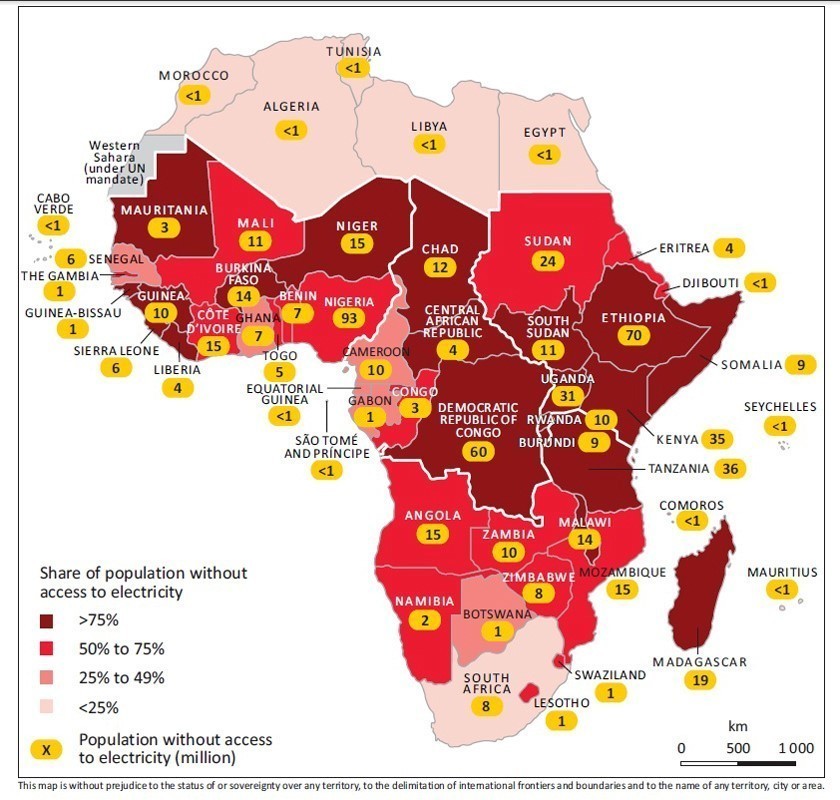
In no place is that more true than Africa, a continent that has yet to see all the benefits of previous industrial revolutions. Today, only 40% of Africans have a reliable energy supply, and just 20% of people on the continent have internet access.
 African countries with a majority living without electricity
And yet, with all of Africa’s unique resources – from its young and growing labour force to its largely untapped internal markets – this coming digital revolution offers unprecedented opportunities. From 11 to 13 May, it’s these opportunities that we’ll be exploring in Kigali with some of the region’s leading minds in business, politics and academia.

Ahead of the meeting, we’re launching a series of articles that will provide some context on the different issues being discussed.
Africa’s digital and cultural revolution
If steam engines, electricity and IT were what defined the previous three industrial revolutions, this latest one is powered by a whole range of exponential technologies that have the potential to change the world as we know it.

“As the continent transitions from the margins to the mainstream of the global economy, technology is playing an increasingly significant role,” says Jake Bright in a piece exploring the seven trends behind the continent’s digital future. You may have heard of Silicon Valley, but what about its Africa counterpart, Silicon Savannah? And that’s just one of many, Bright notes.

“Across the region a Silicon Valley inspired network is developing. The research I’ve done with Aubrey Hruby highlights the existence of roughly 200 African innovation hubs, 3,500 new tech related ventures, and $1 billion in venture capital to a pan-African movement of start-up entrepreneurs.”
Venture capitalist funding to African tech start-ups
But while the theme of technology dominates any discussion on the digital revolution and the way it could transform Africa, we must not lose sight of its cultural aspects. As Funmi Iyanda writes, “Africa doesn’t just need a digital revolution – it needs a cultural one, too”.
Interestingly, this same digital revolution could spark a cultural renaissance: “A social pan-Africanism existed even before the digital revolution through cross-border trade, but it was often hampered by unimaginative and rigid archaic laws,” she writes. Today, Iyanda argues, digital technologies are helping young Africans forge a sense of cultural cohesion that could lead to wider continental integration.
A people’s revolution
While exponential technologies might be the driving force behind the digital revolution, it is Africa’s most important resource – its people – who can determine the direction it will take.
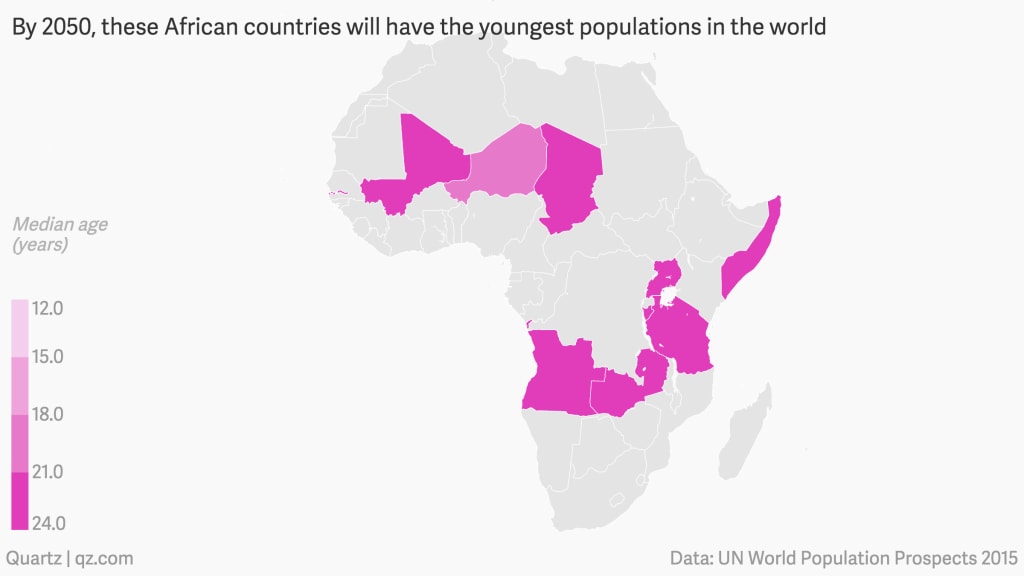
With one of the fastest growing youth populations in the world, the next generation of Africans will lead the way, says Mokena Makeka.
 By 2050, these African countries will have the youngest populations in the world
But first, they must be given the space and opportunities to do so: “Africa’s biggest challenge over the next five years will be how it reconciles the demands of its strident youth – and their take on how to shape the post-colonial continent – in the face of established and entrenched power structures,” he argues.
How, though, do we create these opportunities? Fred Swaniker, who founded the African Leadership Network, has an idea: “Good leaders do not fall from the sky. The experience of successful nations points to the centrality of strong education institutions, and particularly robust higher education systems, in deliberately training the leaders who take societies to great heights.”
Which is why African policy-makers should be worried – the system is “at breaking point,” Swaniker writes. “The current state of higher education across the continent is a real threat to the dream of an African Century,” with low enrollment rates and stretched teaching staff.
 Gross enrollment ratio in tertiary education
His bold ambition is to rethink the way Africa’s next generation of leaders are trained: “At the African Leadership University, we have designed a university system that is built not around a scarce African resource – professors with PhDs – but around a resource we have in abundance – brilliant young students.”
Brilliant young minds is one thing Africa is not short of. Take the example of Ory Okolloh and Juliana Rotich, two Kenyan digital activists behind Ushahidi, a crisis-mapping tool. If Africa is to make the most of the opportunities offered by this digital revolution, it needs more bold, female innovators like them, argues Bineta Diop.
As the African Union’s Special Envoy for Women, Peace and Security, and the founder of her own NGO, she has a powerful message for other women on the continent: “I would like to invite young girls and women in Africa to embrace the fields of science, technology, engineering and mathematics, to help solve the problems facing our communities. Doing so would allow our continent to shift from an exporter of raw materials into a powerhouse of manufacturing, industry and job creation.”
Africa at a crossroads
The wider message from all the contributors to the series is this: it is Africans themselves who have the power to shape their continent’s transformation.
Take trade. Africa’s largest untapped market and its biggest opportunity for progress is right on its doorstep: “In 2014 in Europe, 69% of exports were to other countries on the continent. In Asia, that figure stood at 52% and in North America at 50%. Africa had the lowest level of intra-regional trade, at just 18%,” writes Jacqueline Musiitwa. She shares three things African decision-makers must do now to unlock that potential, including building the right infrastructure and connecting more people on the continent to the internet.
 Share of population without electricity in Africa
Image: International Energy Agency
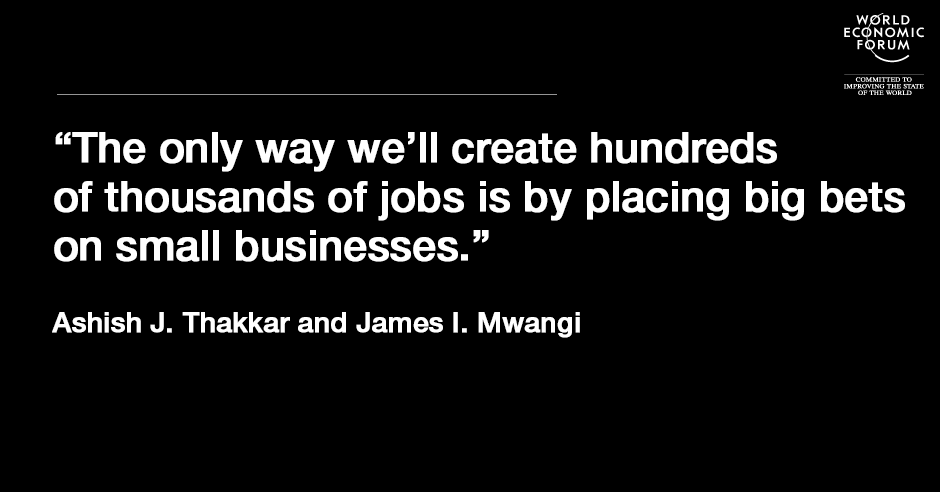
Two leading African entrepreneurs are in agreement. For Ashish j. Thakkar and James I. Mwangi – both of whom sit on the United Nations Foundation’s Global Entrepreneurship Council – small and medium business owners on the continent could create the jobs and economic growth Africa needs to thrive.
“The only way we’ll create hundreds of thousands of jobs is by placing big bets on small businesses. SMEs represent 78% of jobs in low-income countries and more than 90% of all new jobs created each year. These businesses are the true global engines of employment. Increasing rates of entrepreneurship and accelerating the rate at which ventures grow is the only realistic path to creating enough jobs for the next generation.”
This is just a glimpse into all the issues we’ll discuss in Kigali. I invite you to join in the conversation by following the livestream sessions and sharing your thoughts on Africa’s future using #AF16

A brief overview of Africa’s tech industry – and 7 predictions for its future

Mwaura Kirore, a creative director at Planet Rackus, works on MA3Racer, a 2D mobile game inside his studio in Kenya's capital Nairobi, July 15, 2014.
As Africa transitions from the margins to the mainstream of the global economy, technology is playing an increasingly significant role. Bolstering regional trends in business, investment and modernization is the emergence of an IT ecosystem – a growing patchwork of entrepreneurs, tech ventures and innovation centres coalescing from country to country. Nigeria is a hotbed for start-up activity. Facebook, Netflix and SAP have recently expanded in Africa. And Silicon Valley investment is funnelling into ventures from South Africa to Kenya.

The rise of Silicon Savannah
Most discussions of the origins of Africa’s tech movement circle back to Kenya, which laid down four markers between 2007 and 2010 to inspire the country’s Silicon Savannah moniker: mobile money, a globally recognized crowdsourcing app, Africa’s tech incubator model, and a genuine government commitment to ICT policy.

In 2007, Kenyan telecom Safaricom launched the M-Pesa mobile money product. It grew rapidly to become perhaps Africa’s most recognized example of technological leapfrogging: launching ordinary citizens with mobile phones right over bricks-and-mortar banking into the digital economy. Shortly after M-Pesa’s introduction, four technologists created the Ushahidi crowdsourcing app, a highly effective tool for digitally mapping demographic events anywhere in the world. Ushahidi has since become an international tech company with multiple applications in over 20 countries.

In 2008, Ushahidi co-founder Erik Hersman hatched Nairobi’s iHub innovation centre after identifying the need to create a “nexus point for technologists, investors and tech companies”. Since 2010, iHub has produced 152 companies and grown a membership base of nearly 20,000 techies. iHub influenced Africa’s incubator movement, inspiring the upsurge in tech hubs across the continent.

Another Kenyan milestone was the government’s 2010 completion of The East African Marine System (TEAMS) undersea fibre optic cable project. TEAMS increased East African broadband and led to the establishment of Kenya’s Information and Communication Technology (ICT) Authority.

Africa’s emerging tech landscape
Notable as it has become, Silicon Savannah is but one corner of Sub-Saharan Africa’s tech scene. Across the region a Silicon Valley inspired network is developing. The research I’ve done with Aubrey Hruby highlights the existence of roughly 200 African innovation hubs, 3,500 new tech-related ventures, and $1 billion in venture capital (VC) to a pan-African movement of start-up entrepreneurs.
Venture capital funding to African tech start-ups
Increasingly, Nigeria is becoming a centre for big tech investment and commercially oriented start-ups. Whatever the country’s challenges, investors and entrepreneurs are attracted by the prospect of scaling applications to Africa’s largest population and economy. Many have set up shop in Lagos’s Yaba district. There you can find the headquarters for e-commerce start-up Africa Internet Group and digital payments venture Paga, located near incubators Andela and Co-Creation Hub.

Nigeria’s tech sector is becoming representative of repatriate entrepreneurs reversing some of Africa’s brain drain and IT reshaping the continent’s global linkages. All three of Africa’s most recognized e-commerce startups – Jumia, Konga and MallforAfrica – were founded by Nigerians who earned their university degrees and initial private sector experience in the US. A noteworthy portion of the roughly $600 million in VC to these entities comes from American and European investment firms. And the management of Jumia’s parent, Africa Internet Group, is a mix of repatriate Africans and MBA types from the US and Europe attracted to the continent’s IT opportunities over development work.

From Nigeria to Kenya, and Rwanda to Ghana, tech innovation is starting to influence multiple sectors: energy, agriculture, banking, healthcare, entertainment, transport and fashion.
Having researched the topic for the past six years, I believe technology in Africa has the potential to create more impact faster than anywhere previously in the world. There’ll be a lot to unpack on that prediction. To start, here are some trends to watch in the continent’s wired future.

Seven things to expect in African tech’s future
1. Start-ups leap into Africa’s informal economy
The African Development Bank estimates that 55% of sub-Saharan Africa’s economic activity is informal. That’s a massive commercial space without such services as business enterprise software, small business banking, affordable third-party logistics or internet access. Expect VC-backed start-ups to attempt scalable applications for nearly every corner of Africa’s informal economy.
Much of this is already occurring in Nigeria. First-time dotcoms are sprouting up for everything from e-commerce logistics, online auto sales and real-estate listings, to airline bookings, employment sites and credit rating services. The opportunities are infinite, especially as Africa’s broadband and smartphone penetration rates continue to improve.

2. State-to-state ICT competition
Following the lead of countries such as South Africa, Botswana and Kenya, there are growing expectations on African governments to flesh out ICT plans and infrastructure. Countries such as Ethiopia, Nigeria and Ghana are already feeling the pressure, conscious of the success of Silicon Savannah and recent gains by the government of Rwanda.

3. Tech disrupting development
IT will continue to be employed to solve long-standing African socio-economic issues. Aid-agency grants previously going to NGOs are already being diverted to social-venture focused African tech organizations. IBM’s Lucy Project is directed at solving “Africa’s grand challenges” – many of which have been relegated to the development sector. Cracking the continent’s long-standing problems will increasingly become a commercial tech opportunity.

4. African tech solutions with global application
M-Pesa has become a case study for global digital payments. Ushahidi was used in the 2012 US presidential election. Africa’s solar powered BRCK wifi device is bringing connectivity to internet deadspots in Wisconsin. Uber is experimenting with new service models in Africa that company executives tell me could later apply to operations globally. Commercial drone delivery is likely to take off first in Africa. Most of SSA’s tech applications are developing as solutions to local challenges, but this is creating unforeseen opportunities for other markets.

5. IT impacting Africa’s politics
Ushahidi played a role in Kenya’s last two elections. Digital media investigative site Sahara Reporters’ corruption reporting has led to the dismissal of senior Nigerian government officials. Social media applications Twitter and Facebook were heavily utilized by civil society organizations, opposition groups and political parties in Nigeria’s last presidential election. And African technology actors are closer to creating industry lobbying groups. As Sub-Saharan Africa and its citizens become even more connected to the digital grid, expect IT to influence how politics and elections are done.

6. Failure
I throw this in for balance. Among sub-Saharan Africa’s start-ups in particular, there will be many failures. Most of these ventures are operating in ICT environments lacking much of the baseline infrastructure for tech – namely affordable broadband and regular electricity. But as I’ve often pointed out to sceptics of African IT, failure is not necessarily a bad thing. It shows investors and entrepreneurs are committed and trying. Some 90% of US start-ups fail. But that means 10% succeed. A similar principle will apply in Africa. The momentum leading many African start-ups to fail will inevitably lead to the handful of monumental technological successes.

7. Sub-Sahara Africa’s first start-up unicorns and IPOs
Following trend 6, it’s only a matter of time before some of the region’s commercially oriented start-ups create Africa’s first big headlines, i.e. IPOs, acquisitions and unicorns. We already had a preview of this with Africa Internet Group’s recent Goldman Sachs-backed billion dollar valuation, followed by reports that fintech company Interswitch may soon go public on a major exchange – likely the London Stock Exchange.